

Vacuum-Packed Rice Trends: What Buyers Should Test Before Adding Premium Bags
Published on: June 12, 2026
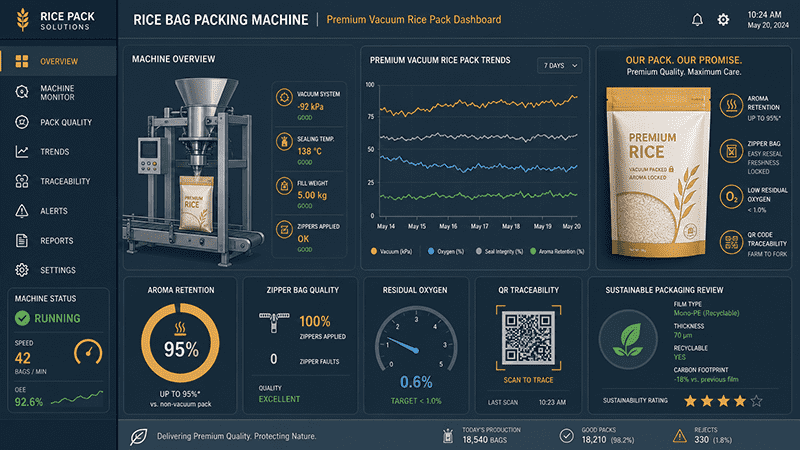
Vacuum-packed rice is moving beyond basic shelf-life packaging. Premium rice brands now care about aroma, pack feel, resealing, traceability, and material claims. A rice bag packing machine must support those goals without damaging grains or creating weak seals.
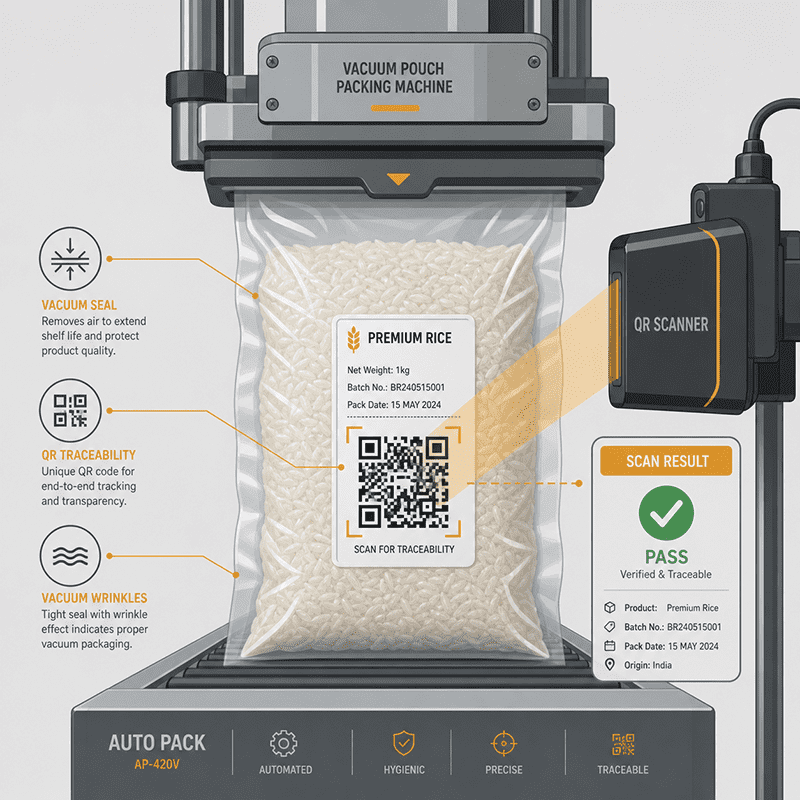
The safest way to evaluate a trend is to turn it into a test. If the bag adds a zipper, test opening and resealing. If the package adds a QR code, test scanning after vacuum collapse. If the brand changes to recyclable or recycled-content film, test food-contact documents, barrier data, and seal strength.
Premium rice
Aroma and whole-grain appearance become more important.
Convenience
Resealable bags help after the first opening.
Smart packs
QR codes must remain scannable after the pack forms.
Materials
Sustainability claims need food-contact and barrier review.
Premium Rice Needs Softer Process Control
A rice vacuum packing machine can extend shelf life, but premium rice also needs texture and aroma protection. The wrong vacuum recipe can create a hard pack that breaks polished grains or flattens the shelf appearance.
For jasmine, basmati, organic rice, or regional specialty grains, buyers should ask for product-specific trials. Measure broken-rice percentage, package firmness, residual oxygen, seal strength, and aroma after storage simulation.
| Trend | Buyer test | Failure sign |
|---|---|---|
| Premium rice packs | Aroma and broken-rice check after storage | Flat aroma or more broken grains |
| Nitrogen flushing | Residual oxygen and bag firmness | Soft pack drift or high oxygen |
| Zipper bag | Open-close cycle and seal interference | Poor reseal or zipper heat damage |
| QR traceability | Scan after vacuum and carton compression | Wrinkled or distorted code |
Nitrogen Flushing and MAP Are Useful Only With Records
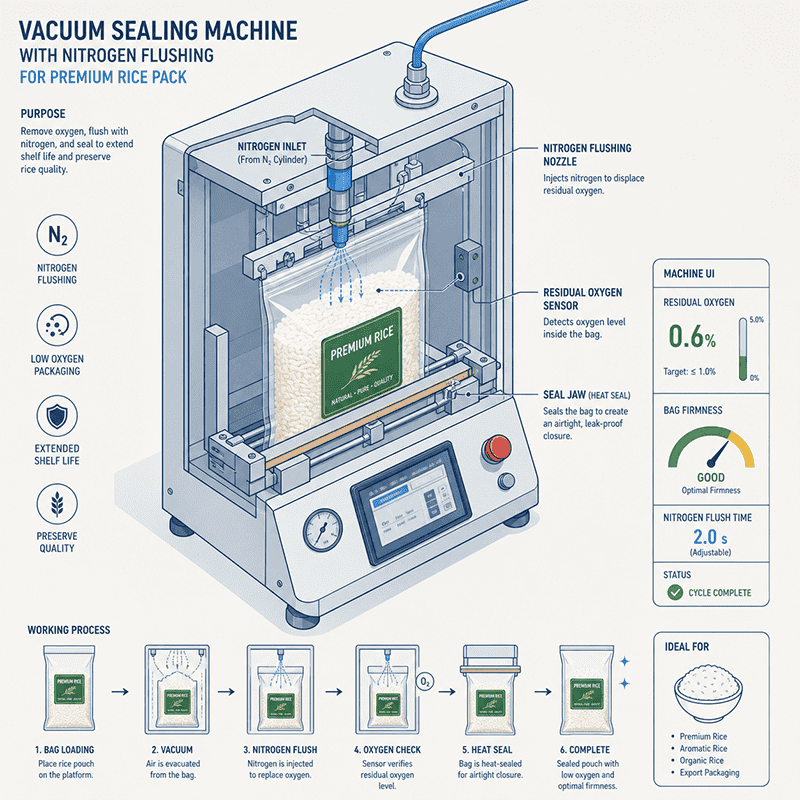
A vacuum sealing machine with nitrogen flushing can reduce hard compression while controlling oxygen exposure. That helps when a brand wants softer pack feel and better grain appearance. The line should record gas flow, residual oxygen, vacuum time, seal temperature, and package firmness.
If those values are not measured, the buyer cannot tell whether MAP control is working or just adding cost.
Sustainable Film Claims Need Proof
Recyclable, biodegradable, or recycled-content film can support brand positioning, but food-contact suitability and barrier performance must be reviewed. FDA explains that recycled plastics for food packaging require attention to contaminants, source control, and additive compliance.
For connected packaging, GS1 Digital Link can connect a 2D code to product information, certifications, traceability information, and usage content. The code still needs to remain readable after vacuum forming.
External references: FDA Recycled Plastics in Food Packaging, GS1 Digital Link, and ISO 22000 food safety management.
Contact our engineering team directly:
Email: export@jialong.cn
WhatsApp: +86-136-2579-4992
Products: rice bag packing machine