

Why Vacuum-Packed Rice Loses Freshness After a Small Leak or Moisture Drift
Published on: June 3, 2026
Vacuum rice packaging looks simple after the bag becomes tight. The risk starts when the package leaves the machine. A small scratch can let air return. A weak seal can split during carton compression. Rice with unstable moisture can create condensation when the warehouse temperature changes.
A vacuum bag packing machine helps only when the whole chain is controlled. Film choice, seal quality, carton design, storage temperature, and retail stacking all decide whether the vacuum effect survives long enough to protect the rice.
Problem 1
Punctures, scratches, and seal splits let oxygen return into the pack.
Problem 2
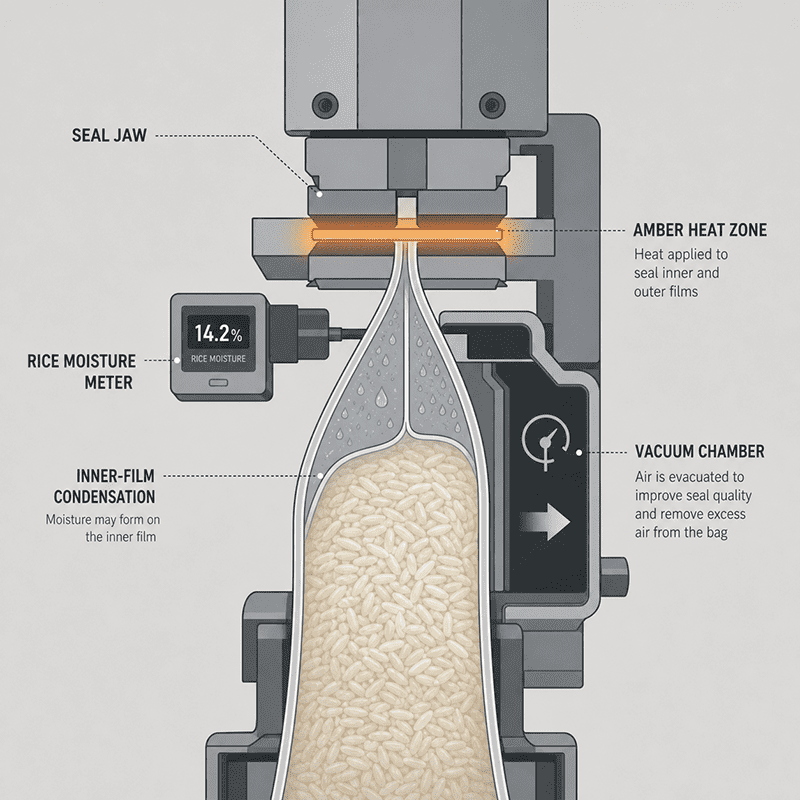
High grain moisture and temperature cycling can create inner-film condensation.
Physical Damage Is Usually Small Before It Is Expensive
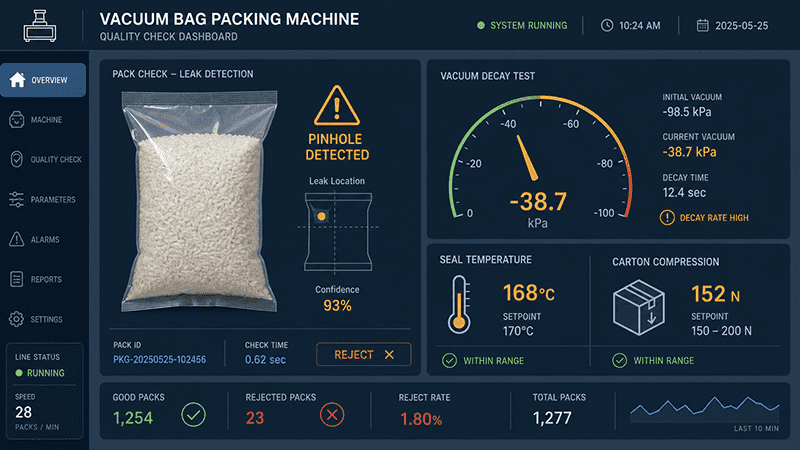
Most leak failures do not start as a large tear. They start as an edge rub, a hard corner, a scratched film surface, or a seal wrinkle. Once air returns, the vacuum protection against insects, oxidation, and mold pressure is weakened.
A food packaging vacuum machine should therefore be tested beyond the normal sealing cycle. The buyer should ask for sample bags to be dropped in cartons, rubbed against partitions, stacked under expected load, and checked again for vacuum decay.
Use puncture-resistant composite film for heavy or hard brick packs.
Confirm seal strength with peel testing after the pack cools.
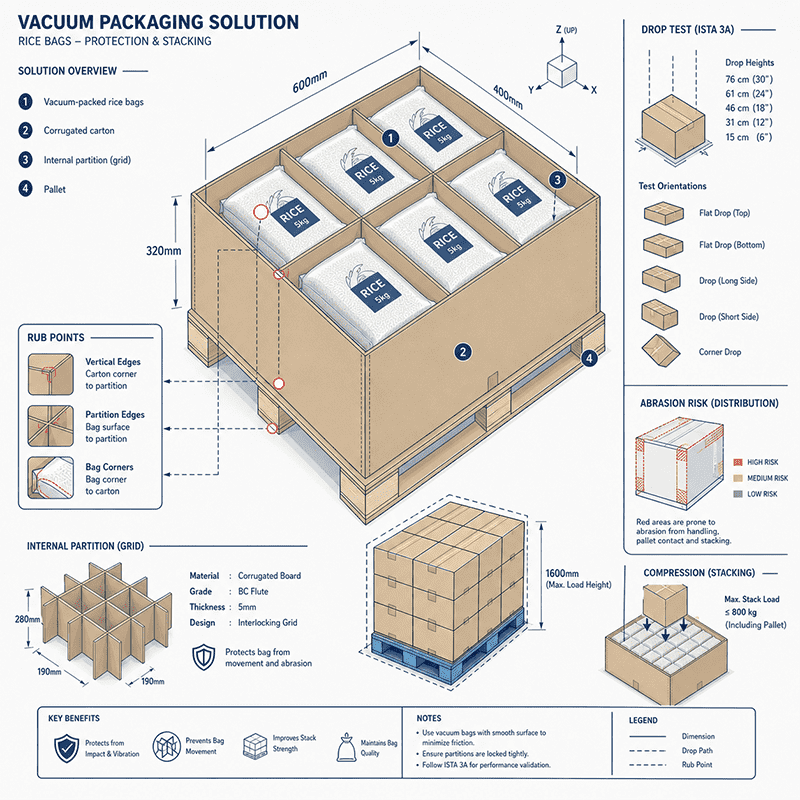
Use carton partitions when rigid packs rub against each other.
Limit pallet height if compression creates corner wear.
Moisture Drift Can Damage Taste Without a Visible Leak
Rice contains moisture even when it looks dry. If the rice is sealed before it reaches a stable moisture level, that water remains trapped inside the package. Temperature changes can move vapor to the inner film surface and then back onto the grain.
IRRI's Rice Knowledge Bank warns that grain stored above 14% moisture may face mold growth, faster quality loss, and reduced eating quality. For retail rice, the moisture record should be checked before the vacuum bag packing machine starts production.
| Risk | What the buyer should ask | Machine or process check |
|---|---|---|
| Air returns after shipment | Was the pack tested after carton handling? | Vacuum decay after drop and compression |
| Seal splits | Was seal strength recorded by batch? | Vacuum pouch sealing machine jaw temperature and dwell time |
| Condensation appears | Was rice moisture released before packing? | Moisture meter record before the vacuum bag packing machine run |
Better Countermeasures Are Operational, Not Decorative
Good packaging is not only a stronger bag. It is a controlled sequence. Rice must be dried and released. Film must fit the package weight. The vacuum bag packing machine must use stable jaw temperature and dwell time. Cartons must prevent hard packs from cutting into each other.
For food-contact materials, FDA provides guidance for packaging and substances that contact food. Rice brands should review film, ink, adhesive, zipper, and valve selections before buying new packaging material. The FDA page on food packaging and food contact substances is a useful starting point.
Practical Buying Guidance
Ask the supplier to test the pack with your rice, your film, your carton, and your storage route. A vacuum bag packing machine that works on a sample table may still need adjustment after the package is stacked, transported, and displayed.
The final approval should include vacuum decay, seal peel strength, moisture record, carton compression result, and a short shelf simulation. Those checks are less expensive than finding failed vacuum packs after distribution.
Contact our engineering team directly:
Email: export@jialong.cn
WhatsApp: +86-136-2579-4992
Products: vacuum bag packing machine